


Optimization of the Extraction Process of Changyan Heji Ⅱ Based on UPLC-Q-TOF-MS/MS Combined with Response Surface Method and Principal Component Analysis
-
摘要:目的
基于UPLC-Q-TOF-MS/MS技术结合响应面分析构建肠炎合剂Ⅱ提取工艺方法,并对其提取工艺进行优化。
方法通过UPLC-Q-TOF-MS/MS技术对肠炎合剂Ⅱ中化学成分进行定性分析,并挑选出质谱响应度有较好线性关系的化学成分为工艺考察指标;利用Box-Behnken设计对提取工艺参数(加水量、提取时间及浸泡时间)进行考察;通过主成分分析(Principal component analysis,PCA)得到综合评分,并以综合得分结合响应面分析确定最优工艺。
结果通过定性分析从肠炎合剂Ⅱ中推测和鉴定了110个成分,包括有机酸2种、黄酮类82种、萜类化合物13种、生物碱类13种,基于定性分析结果,通过UPLC-Q-TOF-MS/MS结合Masshunter质谱数据分析软件导出48个具有良好线性关系的指标成分质谱响应度,进行PCA并计算综合得分,以综合得分为指标进行响应面分析,综合响应面预测结果及生产实际得到的最优提取工艺为:浸泡45 min,溶剂倍量8倍,提取2次,每次120 min。
结论为中药复方提取工艺的考察提供了一种新思路, 为中药复方开发拓展一种新方法。
Abstract:OBJECTIVETo establish a extraction process of Changyan Heji Ⅱ (CYHJ-Ⅱ) based on UPLC-Q-TOF-MS/MS technology combined with response surface analysis, and to optimize the extraction process.
METHODSThe chemical components in CYHJ-Ⅱ were qualitatively analyzed by UPLC-Q-TOF-MS/MS technology, and the chemical components with good linear relationship in mass spectrometry response were selected as process investigation indicators; the extraction process parameters (water addition amount, extraction time and soaking time) were investigated by Box-Behnken design; the comprehensive score was obtained by principal component analysis (PCA), and the optimal process was determined by the comprehensive score combined with response surface analysis.
RESULTSThrough qualitative analysis, 110 components were inferred and identified from CYHJ-Ⅱ, including 2 organic acids, 82 flavonoids, 13 terpenoids, and 13 alkaloids. Based on the results of qualitative analysis, 48 index components with good linear relationships were derived by UPLC-Q-TOF-MS/MS combined with Masshunter mass spectrometry data analysis software. PCA was performed and the comprehensive score was calculated. Response surface analysis was performed with the comprehensive score as an indicator. The optimal extraction process obtained by combining the response surface prediction results and actual production was: soaking for 45 min, 8 times the amount of solvent, 2 extractions, each time for 120 min.
CONCLUSIONThis study provides a new idea for the investigation of the extraction process of traditional Chinese medicine compound prescriptions and expands a new method for the development of traditional Chinese medicine compound prescriptions.
-
中药复方制剂工艺优化是提升药品质量的关键环节。肠炎合剂Ⅱ(苏药制字Z04000809)作为南京市中医院治疗湿热型肠炎的经验方,由葛根、黄芩、黄连、甘草、木香、白芍6味药组成,其院内制剂工艺是以上6味药加水煎煮2次,第1次加水4 000 mL,第2次加水3 000 mL,每次煮沸1.5 h,合并煎液,静置12 h,取上清液浓缩至1 000 mL,分装,100 ℃流通蒸气灭菌30 min,即得。然而,中药复方多成分、多靶点的特性导致传统工艺优化方法面临显著挑战:基于高效液相色谱(HPLC)的定量分析需依赖特定对照品,而中药材中众多活性成分(如黄酮类、生物碱类)的对照品获取困难且成本高昂[1-2];现有研究多局限于检测1~3种标志物,难以全面反映煎煮参数(如加水量、煎煮时间)对复方整体成分溶出规律的影响,这种“以偏概全”的优化策略可能造成关键工艺参数的误判。
近年来,高分辨质谱技术的突破为中药复杂体系分析提供了新思路。现代研究表明[3-4],UPLC-Q-TOF-MS/MS的质谱响应强度与化合物浓度在特定范围内呈线性相关,这为通过响应值变化间接评估成分含量提供了理论依据。基于上述思路,本文构建了一种基于UPLC-Q-TOF-MS/MS的中药化学成分质谱响应度的一种半定量方法。结合主成分分析(Principal component analysis,PCA)得到不同工艺的综合评分,再通过响应面进行处理,用于肠炎合剂Ⅱ的提取工艺考察。该方法在结合生产实际简化实验过程的同时,不仅有效节省工业生产中时间成本,也能得到中药复方的最佳优化工艺,满足了中药制剂开发过程中对工艺考察的要求。
1. 材料
1.1 仪器
1290 Infinity超高效液相色谱仪(美国安捷伦科技有限公司);6538 Q-TOF质谱仪(美国安捷伦科技有限公司);HSS T3 C18色谱柱(美国赛默飞世尔科技公司);Milli-Q纯水仪(上海密理博有限公司);Mettler Toledo XS205DU十万分之一电子天平(梅特勒-托利多仪器有限公司);Mettler Toledo ME303E万分之一电子天平(梅特勒-托利多仪器有限公司);Centrifuge 5424R高速离心机(德国Eppendorf公司);KH2200B超声波清洗器(昆山禾创超声仪器有限公司);调温电热器(南通市通州申通电热器厂)。IKA HB10蒸发仪(艾卡仪器设备有限公司)。
1.2 试剂与药材
葛根(批号Y20230926)、黄芩(批号Y20230926)、甘草(批号Y20230926)、木香(批号Y20230926)、白芍(批号Y20230926)、黄连(批号20230926)均购自亳州万珍中药饮片厂,经连云港康济大药房连锁有限公司吴舟职业药师鉴定,均符合2020年版《中国药典》规定。乙腈、甲醇、乙醇(南京化学试剂股份有限公司);甘草酸铵(批号110731-201418)、甘草次酸(批号110723-201514)、汉黄芩素(批号111514-201706)、甘草苷(批号111610-201908)、黄芩苷(批号110715-201318)、汉黄芩苷(批号112002-201702)、黄芩素(批号111595-201306)、夏佛塔苷(批号111809-201403)、芒柄花素(批号111703-201504)、芒柄花苷(批号111702-201606)、大豆苷(批号111738-201603)、大豆苷元(批号111502-202003)、葛根素(批号110752-201615)、染料木苷(批号111709-201702)、染料木素(批号111704-201302)、芍药苷(批号110736-201943)、没食子酸(批号110831-201204)、牡荆素(批号111668-200602)、木香烃内酯(批号111524-201711)、去氢木香烃内酯(批号111525-201711)均购自中国食品药品检定研究院;甘草酸(批号MUST-16070805)、异夏佛塔苷(批号MUST-17041908)、小檗碱(批号MUST-11122104)购自成都曼斯特生物科技有限公司;异甘草苷(批号Y15A10H95344)、新甘草苷(批号Y28S6H3980)、芹糖甘草苷(批号Y12J10H90496)、氧化芍药苷(批号ST13230220)、苯甲酰芍药苷(批号20131022)、芍药内酯苷(批号20140214)购自上海源叶生物科技有限公司;甘草素(批号111525-201711)、异甘草素(批号111525-201711)购自成都普菲德生物技术有限公司,各对照品质量分数均≥98%;色谱纯乙腈购自美国默克公司;甲酸为色谱纯,购自ROE SCIENTIFIC INC;水为自制超纯水。
2. 方法
2.1 肠炎合剂Ⅱ供试品和对照品溶液制备
2.1.1 供试品溶液配制
参照院内制剂肠炎合剂Ⅱ处方量(葛根36 g,黄芩30 g,黄连9 g,木香18 g,白芍30 g,甘草18 g)进行饮片称量,基于前期单因素实验结果选择工艺考察参数。各试验号样品按照表 1因素水平进行浸泡、加热提取、合并煎液、最后浓缩。得到的浓缩样品进行质谱进样前处理,统一用1 g生药量对应浓缩液用乙醇稀释30倍,得到供试品。
表 1 肠炎合剂Ⅱ提取工艺响应面优化设计Table 1. Response surface optimization design for the decoction process of CYHJ-Ⅱ试验号 因素 试验号 因素 A/min B/倍 C/min A/min B/倍 C/min S1 15 8 120 S10 30 10 90 S2 45 8 120 S11 30 8 150 S3 15 10 120 S12 30 10 150 S4 45 10 120 S13 30 9 120 S5 15 9 90 S14 30 9 120 S6 45 9 90 S15 30 9 120 S7 15 9 150 S16 30 9 120 S8 45 9 150 S17 30 9 120 S9 30 8 90 2.1.2 对照品溶液配制
精密称取对照品汉黄芩素、甘草酸、甘草苷、异甘草苷、甘草素、异甘草素、甘草酸铵、甘草次酸、新甘草苷、芹糖甘草苷、黄芩苷、汉黄芩苷、黄芩素、夏佛塔苷、异夏佛塔苷、芒柄花素、芒柄花苷、大豆苷、大豆苷元、葛根素、小檗碱、表小檗碱、染料木苷、染料木素、芍药苷、氧化芍药苷、苯甲酰芍药苷、芍药内酯苷、没食子酸、牡荆素、木香烃内酯、去氢木香烃内酯对照品适量,分别加甲醇配置成0.1 mg·mL-1的溶液,备用。
2.2 色谱及质谱条件
2.2.1 色谱条件
HSS T3色谱柱(2.1 mm×100 mm, 1.8 μm),流动相:0.1%甲酸水(A)-乙腈(B),梯度洗脱(0~3 min,2%~10%B;3~20 min,10%~30%B;20~30 min,30%~50%B;30~40 min,50%~80%B; 40~45 min,80%~95%B;45~46 min,95%~2%B;46~50 min,2%B),柱温35 ℃,流速0.3 mL·min-1,进样量3 μL。
2.2.2 质谱条件
采用电喷雾离子源(ESI),正负离子模式,扫描范围m/z 100~1 500;干燥气体流量8 L·min-1;干燥气温度350 ℃;雾化气压力40 psi;裂解电压135 V;锥孔电压65 V;毛细管电压正离子模式4 000 V,负离子模式3 500 V;碰撞能量10、20、30、40 V。
2.3 UPLC-Q-TOF-MS/MS分析肠炎合剂Ⅱ提取工艺
中药复方以多成分、多靶点协同作用发挥药效,单一或几个成分不能全面反映其整体特征,而质谱能够分析足够多的成分,具有整体性的特点[5]。随着现代科学技术的发展,质谱分析技术趋于成熟,因其宏观分析应用于提取工艺评价的优势,可对中药复方含复杂成分进行定性及提取工艺优化[6-8]。
由于肠炎合剂Ⅱ是基于院内制剂,在尊重院内制剂原方工艺基础上,应参照《医疗机构中药煎药室管理规范》(国中医药发〔2009〕3号)并结合具体情况,合理确定制备工艺[9]。因此,基于原方工艺,结合文献调研和前期单因素实验结果,确定最佳的煎煮次数为2次,以确保药材中的有效成分能够充分释放[10-14]。在此基础上选取浸泡时间(A)、加水量(B)、提取时间(C)为考察因素,因素水平见表 1,按表 1制备得到17批试验样品。
2.3.1 色谱条件
条件同“2.2.1”。
2.3.2 质谱条件
条件同“2.2.2”。
2.4 工艺考察指标筛选
2.4.1 线性关系考察
分别精密量取“2.1.2”项下制备的供试品溶液各1 mL,用乙醇分别稀释3、4、5、6、7、8、9倍,制得各稀释倍数的供试品溶液,分别按照“2.3.1”项下色谱条件进行测定,以稀释倍数为横坐标(X),峰面积为纵坐标(Y)进行线性回归,得到回归方程、相关系数(R2)和线性范围。结果见表 2。
表 2 肠炎合剂Ⅱ的UPLC-Q-TOF-MS/MS鉴定Table 2. UPLC-Q-TOF-MS/MS identification of CYHJ-Ⅱ序号 tR/min 准分子离子峰 理论值 实测值 偏差(×10-6) 分子式 化合物 MS/MS 线性关系 中药归属 1 1.014 [M-H]- 133.014 0 133.014 3 2.26 C4H6O5 苹果酸 115.003 8[M-H-H2O]-;71.014 5[M-H-CH2O3]- - HL 2 1.412 [M-H]- 191.019 7 191.020 2 2.62 C6H8O7 柠檬酸 111.008 7[M-H-CH4O4]- - HL 3 4.360 [M-H]- 593.151 2 593.152 5 2.19 C27H30O15 木犀草素-7-O-芸香糖苷 112.985 6[M-H-C23H29O11]- - HQ 4 4.451 [M+H]+ 579.170 8 579.170 7 -0.17 C27H30O14 葛根素-4′-O-葡萄糖苷 417.118 6[M+H-glu]+;
297.075 9[M+H-glu-C4H8O4]+- GG 5 5.000 [M+H]+ 711.213 1 711.212 5 -0.84 C32H38O18 美佛辛-4′-O-葡萄糖苷 579.171 8[M+H-api]+;
417.121 2[M+H-api-glu]+- GG 6a 5.110 [M+H]+ 433.112 9 433.112 8 -0.23 C21H20O10 3′-羟基葛根素 313.070 3[M+H-C8H7O]+ Y=(5×10⁶)X+798 337
R2=0.988 1
线性范围1 332 962~2 499 526GG 7 5.203 [M+H]+ 579.170 8 579.170 7 -0.17 C27H30O14 大豆苷元4′, 7-二葡萄糖苷 417.118 7[M+H-glu]+;
255.065 2[M+H-2glu]+- GG 8a 5.608 [M+H]+ 609.181 4 609.181 2 -0.33 C28H32O15 葛花苷 315.765 0[M+H-glu-api]+ Y=294 644X+128 15
R2=0.984 5
线性范围43 382~108 390GG 9a 5.754 [M+H]+ 565.155 2 565.155 0 -0.35 C26H28O14 3′-氢化葛根素木糖苷 433.112 6[M+H-api]+;
415.103 1[M+H-api-H2O]+Y=(1×10⁶)X+612 19
R2=0.994 5
线性范围219 393~108 390GG 10as 5.835 [M-H]- 563.140 6 563.140 7 0.18 C26H28O14 夏佛塔苷 311.056 3[M-H-glu-C3H6O3]- Y=297 971X+2 702.4
R2=0.988 1
线性范围29 814~96 776GC 11as 6.353 [M+H]+ 417.118 0 417.118 2 0.48 C21H20O9 葛根素 399.106 8[M+H-H2O]+;
381.096 7[M+H-2H2O]+;
363.086 0[M+H-3H2O]+;297.075 5[M+H-C4H8O4]+Y=(9×10⁶)X+3×10⁶
R2=0.966 5
线性范围3 406 759~5 321 768GG 12 6.650 [M-H]- 447.093 3 447.093 0 -0.67 C21H20O11 槲皮素-7-O-鼠李糖苷 327.052 4[M-H-C5H12O3]-;301.058 7[M-H-rha]- - HL 13a 6.706 [M+H]+ 549.160 3 549.161 0 1.28 C26H28O13 葛根素-7-木糖苷 417.118 02[M+H-api]+ Y=(2×10⁶)X+128 965
R2=0.980 2
线性范围339 114~788 186GG 14a 6.943 [M+H]+ 447.128 6 447.128 6 0.00 C22H22O10 3′-甲氧基葛根素 297.075 2[M-H-C6H14O4]- Y=(6×10⁶)X+971 590
R2=0.985 3
线性范围1 566 023~2 868 435GG 15a 7.053 [M+H]+ 549.160 3 549.160 2 -0.18 C26H28O13 葛根素-木糖苷 417.117 8[M+H-api]+;
297.075 4[M+H-glu-C3H6O3]+Y=(4×10⁶)X+334 216
R2=0.993 1
线性范围789 911~1 704 257GG 16s 7.193 [M+HCOO]- 525.161 4 525.163 5 4.00 C23H28O11 芍药内酯苷 121.029 6[M-H-C16H23O9]- - BS 17 7.228 [M-H]- 593.151 2 593.153 1 3.20 C27H30O15 木犀草素-7-O-芸香糖苷同分异构体 112.985 8[M-H-C23H29O11]- - HQ 18 7.349 [M+H]+ 342.170 0 342.170 0 0.00 C20H24NO4 木兰花碱 297.111 8[M-C2H7N]+;
265.085 2[M-C3H11NO]+- HL 19 7.661 [M-H]- 197.045 5 197.046 9 7.11 C9H10O5 丹参素 124.015 5[M-C2H2O3]- - HL 20 7.749 [M+H]+ 579.170 8 579.170 7 -0.17 C27H30O14 山柰苷 447.129 4[M+H-api]+;
327.085 2[M+H-glu-C3H6O3]+- GG 21 7.893 [M-H]- 593.151 2 593.1531 3.20 C27H30O15 山柰酚-3-O-葡萄糖鼠李糖苷 112.985 7[M-H-C23H29O11]-; - HL 22as 7.949 [M+H]+ 417.118 0 417.118 2 0.48 C21H20O9 大豆苷 255.065 3[M+H-glu]+ Y=(7×10⁶)X+1×10⁶
R2=0.990 3
线性范围1 807 758~3 433 738GG 23s 8.007 [M+H]+ 255.065 2 255.064 9 -1.18 C15H10O4 大豆苷元 227.072 4[M+H-CO]+;
199.074 8[M+H-2CO]+- GG 24as 8.118 [M+HCOO]- 525.161 4 525.162 1 1.33 C23H28O11 芍药苷 121.029 7[M-H-C17H24O11]- Y=813 716X+18 155
R2=0.981 6
线性范围116 823~298 943BS 25a 8.498 [M+H]+ 433.112 9 433.112 8 -0.23 C21H20O10 异牡荆素 415.099 7[M+H-H2O]+ Y=(1×10⁶)X+33 510
R2=0.989 6
线性范围149 553~390 528GG 26a 8.874 [M+H]+ 447.128 6 447.130 3 3.80 C22H22O10 3′-甲氧基大豆苷 285.075 9[M+H-glu]+ Y=(3×10⁶)X+194 278
R2=0.984 9
线性范围479 327~1 096 455GG 27as 8.933 [M-H]- 563.140 6 563.141 6 1.78 C26H28O14 异夏佛塔苷 311.056 2[M-H-glu-C3H6O3]- Y=481 281X+11 869
R2=0.987 4
线性范围69 583~176 206GC 28 9.13 [M-H]- 417.119 1 417.118 8 -0.72 C21H22O9 新甘草苷 255.066 1[M-H-glu]- - GC 29 9.164 [M-H]- 463.088 2 463.091 7 7.56 C21H20O12 槲皮素-7-O-葡萄糖苷 301.057 6[M+H-glu]+ - HL 30 9.252 [M+H]+ 417.118 0 417.118 2 0.48 C21H20O9 葛根素同分异构体 351.084 7[M+H-CH6O3]+;
297.075 6[M+H-C4H8O4]+- GG 31 9.332 [M-H]- 549.161 4 549.160 9 -0.91 C26H30O13 甘草素二糖苷 255.065 3[M-H-glu-api]- - GC 32 9.419 [M+H]+ 257.080 8 257.080 2 -2.33 C15H12O4 甘草素同分异构体 137.023 7[M+H-C4H8O4]+;
119.050 3[M+H-C4H8O4-H2O]+- GC 33as 9.448 [M-H]- 417.119 1 417.116 9 -5.28 C21H22O9 甘草苷 255.066 1[M-H-glu]+ Y=715 060X+9 652.2
R2=0.985 5
线性范围91 112~250 066GC 34as 9.650 [M-H]- 549.161 4 549.161 2 -0.36 C26H30O13 芹糖甘草苷 417.120 3[M-H-api]-;
255.065 9[M-H-api-glu]-Y=712 452X+13 502
R2=0.996 0
线性范围95 490~253 162GC 35as 9.714 [M+H]+ 257.080 8 257.080 6 -0.78 C15H12O4 甘草素 137.022 8[M+H-C7H4O2]+;
119.048 2[M+H-C7H4O2-H2O]+- GC 36 9.857 [M+H]+ 447.128 6 447.130 3 3.80 C22H22O10 5-羟基芒柄花苷 285.075 6[M+H-glu]+ - GG 37 10.148 [M+H]+ 463.087 1 463.085 8 -2.81 C21H18O12 野黄芩苷 287.055 6[M+H-C6H8O6]+ - HQ 38 10.286 [M-H]- 547.145 7 547.145 6 -0.18 C26H28O13 白杨素6-C-阿拉伯糖8-C-葡萄糖苷 487.124 5[M-H-C3H6O3]-;
457.113 9[M-H-C3H6O3]-;
427.104 9[M-H-C4H8O4]-- HQ 39 10.350 [M-H]- 253.050 6 253.050 2 -1.58 C15H10O4 7, 4′-二羟基黄酮 146.220 9[M-H-C6H3O2]-;
91.122 9[M-H-C15H6O3]-- GC 40 10.488 [M-H]- 477.103 8 477.107 7 8.18 C22H22O12 异鼠李素-3-O-葡萄糖苷 315.052 1[M-H-glu]- - HL 41 10.581 [M-H]- 547.145 7 547.144 4 -2.38 C26H28O13 白杨素6-C-阿拉伯糖8-C-葡萄糖苷同分异构体 487.123 0[M-H-C3H6O3]-;
457.113 9[M-H-C3H6O3]-;
427.104 7[M-H-C4H8O4]-- HQ 42 10.782 [M+H]+ 324.123 0 324.122 9 -0.31 C19H18NO4+ 去亚甲基小檗碱 309.101 1[M-CH4]+ - HL 43 10.926 [M-H]- 631.166 8 631.167 0 0.32 C30H31O15 没食子酰芍药苷或同分异构体 509.135 0[M-C6H2O3]-;
491.129 6[M-C6H4O4]-- BS 44a 11.192 [M+H]+ 322.107 4 322.107 6 0.62 C19H16ClNO4 小檗红碱 307.083 4[M-H2O]+;
278.089 3[M-CO2]+Y=969 370X+2 915
R2=0.978 0
线性范围113 277~324 960HL 45 11.269 [M-H]- 547.145 7 547.146 2 0.91 C26H28O13 白杨素6-C-葡萄糖8-C-阿拉伯糖苷 487.121 7[M-H-C3H6O32]-;
457.114 4[M-H-C3H6O3]-;
427.104 0[M-H-C4H8O4]-- HQ 46 11.360 [M+H]+ 324.123 0 324.122 9 -0.31 C19H18NO4+ 去亚甲基小檗碱同分异构体 309.101 9[M-CH4]+ - HL 47 11.481 [M+H]+ 503.118 4 503.118 1 -0.60 C24H22O12 丙二酸单酰大豆苷 255.065 3[M+H-glu-C3H2O3]+ - GG 48 11.645 [M-H]- 547.145 7 547.146 4 1.28 C26H28O13 白杨素6-C-葡萄糖8-C-阿拉伯糖苷异构体 487.132 4[M-H-C2H4O2]-;
457.114 6[M-H-C3H6O3]-;
427.099 9[M-H-C4H8O4]-- HQ 49a 11.765 [M+H]+ 563.175 9 563.175 6 -0.53 C27H30O13 3′-羟基葛根素芹菜糖苷 431.134 3[M+H-api]+ Y=(1×10⁶)X+19 146
R2=0.994 3
线性范围139 056~398 862GG 50 11.851 [M+H]+ 352.117 9 352.117 9 0.00 C20H18NO5+ 1, 3-羟基小檗碱 337.093 8[M-CH3]+;
308.093 2[M-C2H4O]+- HL 51 12.524 [M+H]+ 463.123 5 463.123 9 0.86 C22H22O11 射干苷 301.071 2[M+H-api]+ - GG 52a 13.204 [M-H]- 525.161 4 525.162 1 1.33 C23H28O11 芍药苷同分异构体 121.030 3[M-H-C16H23O9]- Y=(5×10⁶)X+49 209
R2=0.994 9
线性范围541 088~1 589 871BS 53a 13.355 [M+H]+ 320.091 7 320.091 9 0.63 C19H14NO4 黄连碱 292.097 1[M-CH4O]+ Y=(6×10⁶)X+119 799
R2=0.996 5
线性范围732 289~1 988 759HL 54a 13.709 [M+H]+ 477.102 8 477.102 9 0.21 C22H20O12 4′-羟基汉黄芩苷 301.070 9[M+H-C6H8O6]+ Y=894 769X+42 033 R2=0.996 5线性范围155 206~330 171 HQ 55a 13.788 [M+H]+ 338.138 7 338.138 7 0.00 C20H20NO4 非洲防己碱 323.115 2[M-CH3]+;
294.112 3[M-C2H4O]+Y=(3×10⁶)X+78 865
R2=0.994 0
线性范围451 550~1 212 765HL 56as 13.875 [M+H]+ 336.123 0 336.123 4 1.19 C20H18NO4 表小檗碱 320.090 6[M-CH4]+;
292.094 9[M-C2H4O]+Y=(4×10⁶)X+35 216
R2=0.993 0
线性范围443 620~1 338 368HL 57as 14.246 [M-H]- 417.119 1 417.120 0 2.16 C21H22O9 异甘草苷 255.065 8[M-H-glu]- Y=178 077X+592.39
R2=0.982 7
线性范围19 090~60 119GC 58a 14.368 [M+H]+ 338.138 7 338.138 7 0.00 C20H20NO4 药根碱 323.115 1[M-CH3]+;
294.112 3[M-C2H4O]+Y=(4×10⁶)X+94 026
R2=0.996 3
线性范围517 392~1 389 040HL 59a 14.570 [M-H]- 549.161 4 549.163 2 3.28 C26H30O13 芹糖异甘草苷 417.129 2[M-H-glu]-;
255.066 8[M-H-2glu]-Y=144 340X+944.02
R2=0.973 2
线性范围15 148~48 418GC 60 14.605 [M+H]+ 255.065 2 255.064 9 -1.18 C15H10O4 3, 2′-二羟基黄酮 227.068 3[M+H-CO]+;
199.074 6[M+H-2CO]+;
137.023 8[M+H-C7H2O2]+- GG 61a 14.628 [M+H]+ 431.133 7 431.132 8 -2.09 C22H22O9 芒柄花苷 269.080 1[M+H-glu]+ Y=(2×10⁷)X+95 045
R2=0.996 4
线性范围270 878~626 273GG 62s 14.721 [M+H]+ 447.092 2 447.092 3 0.22 C21H18O11 黄芩苷 271.061 3[M+H-C6H8O6]+ - HQ 63 14.859 [M+H]+ 271.060 1 271.057 9 -8.12 C15H10O5 黄芩素同分异构体 241.049 5[M+H-CH2O]+ - HQ 64as 14.894 [M+H]+ 433.112 9 433.112 8 -0.23 C21H20O10 染料木苷 271.060 4[M+H-glu]+ - GG 65s 14.977 [M+H]+ 257.080 8 257.080 6 -0.78 C15H12O4 异甘草素 137.023 2[M+H-120]+ - GC 66 15.314 [M-H]- 447.093 3 447.096 8 7.83 C21H20O11 二氢黄芩苷 271.061 5[M+H-C6H8O6]- - HQ 67 15.401 [M+H]+ 334.107 4 334.107 0 -1.20 C20H16NO4 甲基黄连碱 320.090 8[M-CH2]+;
292.085 6[M-C2H2O]+- HL 68a 16.097 [M+H]+ 447.092 2 447.092 1 -0.22 C21H18O11 黄芩苷同分异构体 271.059 7[M+H-C6H8O6]+ Y=(3×10⁶)X+210 844
R2=0.998 7
线性范围557 645~1 350 291HQ 69as 16.361 [M+H]+ 336.123 0 336.123 4 1.19 C20H18NO4 小檗碱 320.099 2[M-CH3]+;
292.097 4[M-CH3-CHO]+Y=(2×10⁷)X+2×10⁶
R2=0.975 6
线性范围4 188 134~8 850 728HL 70a 16.766 [M+H]+ 352.154 3 352.154 8 1.42 C21H22NO4 巴马汀 337.130 2[M-CH3]+;
308.127 8[M-CH3-CHO]+Y=(1×10⁷)X+364 777
R2=0.994 6
线性范围1 467 496~3 853 176HL 71a 16.939 [M+H]+ 477.102 8 477.102 7 -0.21 C22H20O12 5, 6-二羟基-8-甲氧基黄酮-7-O-葡萄糖醛酸苷 301.070 3[M+H-C6H8O6]+ Y=949 395X+20 816 R2=0.990 6线性范围125 376~333 572 HQ 72a 17.744 [M+H]+ 461.107 8 461.108 1 0.65 C22H20O11 千层纸素苷 285.076 3[M+H-C6H8O6]+;
270.053 2[M+H-C6H8O6-CH3]+Y=(9×10⁶)X+736 301 R2=0.986 7线性范围1 625 523~3 530 594 HQ 73a 17.750 [M+H]+ 477.102 8 477.102 9 0.21 C22H20O12 5, 2′-二羟基-6-甲氧基黄酮-7-O-葡萄糖醛酸苷 301.071 4[M+H-C6H8O6]+ Y=536 770X+12 985
R2=0.964 0
线性范围71 845~189 160HQ 74 17.981 [M+H]+ 447.092 2 447.092 4 0.45 C21H18O11 黄芩苷同分异构体 271.059 5[M+H-C6H8O6]+ - HQ 75as 18.380 [M+H]+ 461.107 8 461.108 1 0.65 C22H20O11 汉黄芩苷 285.076 0[M+H-C6H8O6]+;
270.052 2[M+H-C6H8O6-CH3]+Y=(1×10⁷)X+1×10⁶
R2=0.987 5
线性范围2 563 599~5 220 940HQ 76 18.536 [M+H]+ 285.0757 285.074 4 -4.56 C16H12O5 汉黄芩素同分异构体 270.051 3[M+H-CH3]+ - HQ 77 20.034 [M+H]+ 271.060 1 271.061 7 5.90 C15H10O5 黄芩素同分异构体 241.049 5[M+H-CH2O]+ - HQ 78s 21.328 [M+H]+ 271.060 1 271.060 9 2.95 C15H10O5 黄芩素 241.050 5[M+H-CH2O]+ - HQ 79 22.317 [M-H]- 299.056 1 299.058 3 7.36 C16H12O6 高车前素 284.032 9[M-H-CH3]- - HQ 80as 22.749 [M+H]+ 269.080 8 269.080 6 -0.74 C16H12O4 芒柄花素 254.058 4[M+H-CH3]+ Y=633 010X+5 033.5
R2=0.991 8
线性范围66 152~211 146GG 81a 24.856 [M+H]+ 839.406 0 839.405 6 -0.48 C42H62O17 甘草皂苷G2 663.378 4[M+H-C6H8O6]+;
487.341 0[M+H-2C6H8O6]+Y=134 394X+299.92 R2=0.990 0线性范围16 823~44 804 GC 82 25.353 [M+H]+ 839.406 0 839.405 6 -0.48 C42H62O17 羟基甘草酸 663.377 2[M+H-C6H8O6]+;
487.340 7[M+H-2C6H8O6]+- GC 83as 25.665 [M+H]+ 285.075 7 285.075 1 -2.11 C16H12O5 汉黄芩素 270.051 6[M+H-CH3]+ Y=(5×10⁶)X+111 746
R2=0.993 6
线性范围685 348~1 921 796HQ 84 25.902 [M+H]+ 839.406 0 839.405 6 -0.49 C42H62O17 羟基甘草酸 487.341 9[M+H-2C6H8O6]+ - GC 85as 26.098 [M-H]- 821.396 5 821.396 2 -0.36 C42H62O16 甘草酸 351.057 2[M-H-C30H46O4]-;
193.035 2[M-H-C36H52O9]-;Y=784 786X+18 086
R2=0.995 6
线性范围104 473~277 310GC 86 26.509 [M+H]+ 315.086 3 315.086 2 -0.32 C17H14O6 尼泊尔鸢尾异黄酮 285.039 6[M+H-C2H4]+;
213.037 8[M+H-C3H8O4]+- GG 87a 27.254 [M-H]- 821.396 5 821.397 4 1.10 C42H62O16 乌拉尔甘草皂苷B 351.057 1[M-H-C30H46O4]-;
193.035 7[M-H-C36H52O9]-Y=97 776X+2 104.9
R2=0.937 3
线性范围11 345~33 200GC 88 27.432 [M+H]+ 352.117 9 352.117 8 -0.28 C20H17NO5 氧化小檗碱 337.094 9[M-CH3]+;
322.067 9[M-C2H6]+- HL 89a 27.630 [M-H]- 355.118 7 355.117 6 -3.10 C20H20O6 乌拉尔宁 125.024 6[M-H-C14H14O3]- Y=76 299X+1 810.4
R2=0.940 2
线性范围8 133~26 076GC 90 27.984 [M+H]+ 369.133 3 369.133 2 -0.27 C21H23NO5 别隐品碱 341.137 2[M-CO]+;
313.069 5[M-2CO]+- HL 91 27.780 [M-H]- 821.396 5 821.396 2 -0.37 C42H62O16 Licoricesaponin K2或Licoricesaponin H2 645.270 6[M-H-C6H8O6]-;
469.934 0[M-H-2C6H8O6]-- GC 92a 27.919 [M-H]- 367.118 7 367.119 1 1.09 C21H20O6 甘草香豆素 309.039 7[M-H-C4H10]-;
265.041 4[M-H-C5H10O2]-Y=135 276X+438.37
R2=0.994 6
线性范围11 102~44 071GC 93a 28.214 [M-H]- 351.087 4 351.086 6 -2.28 C20H16O6 半甘草异黄酮B 333.077 4[M-H-H2O]-;
265.087 3[M-H-C5H10O]-Y=71 242X+2 322.4
R2=0.958 3
线性范围10 455~25 555GC 94 28.786 [M-H]- 353.103 1 353.103 2 0.28 C20H18O6 甘草异黄烷酮同分异构体 285.032 5[M-H-C5H8]-;
69.694 5[M-H-284]-- GC 95a 29.278 [M-H]- 353.103 1 353.103 1 0.00 C20H18O6 甘草异黄烷酮 285.113 9[M-H-C5H8]-;
83.013 8[M-H-C15H10O5]-Y=336 421X+10 403
R2=0.964 1
线性范围41 424~123 084GC 96a 30.555 [M-H]- 365.103 1 365.101 0 -5.75 C21H18O6 甘草酚 307.024 4[M-H-C4H10]-;
295.025 1[M-H-C5H10]-Y=30 932X+2 295
R2=0.994 7
线性范围3 672~22 317GC 97as 31.421 [M+H]+ 233.153 6 233.153 9 1.29 C15H20O2 木香烃内酯 187.147 0[M+H-CH2O2]+ Y=725 868X+4 969.2
R2=0.991 3
线性范围79 533~244 298MX 98 31.711 [M-H]- 353.103 1 353.102 9 -0.57 C20H18O6 甘草宁C 297.109 8[M-H-C3H4O]- - GC 99a 31.937 [M-H]- 351.087 4 351.086 9 -1.42 C20H16O6 甘草异黄酮B 283.097 6[M-H-C5H8]-;
265.087 3[M-H-C5H10O]-Y=245 044X+2 637.3
R2=0.989 7
线性范围31 047~85 311GC 100as 32.138 [M+H]+ 231.13 8 231.137 8 -0.87 C15H18O2 去氢木香烃内酯 185.132 5[M+H-CH2O2]+;
143.085 7[M+H-C4H8O2]+Y=(2×10⁶)X+758.62
R2=0.994 3
线性范围182 041~594 263MX 101 32.371 [M+H]+ 233.153 6 233.153 0 -2.58 C15H20O2 木香烃内酯同分异构体 159.116 4[M+H-C3H4O2]+ - MX 102 33.533 [M+H]+ 233.153 6 233.153 4 -0.86 C15H20O2 木香烃内酯同分异构体 187.146 0[M+H-CH2O2]+ - MX 103 33.556 [M-H]- 391.191 5 391.193 1 4.09 C25H28O4 光甘草酚 203.071 7[M-H-C13H16O]- - GC 104a 34.452 [M-H]- 423.181 3 423.179 6 -4.02 C25H28O6 Gancaonin E 229.086 5[M-H-C11H14O3]-;
193.086 5[M-H-C14H14O3]-Y=53 303X-9.532 5
R2=0.976 5
线性范围6 008~18 234GC 105 34.827 [M-H]- 407.186 4 407.186 5 0.25 C25H28O5 3-羟基光甘草酚 219.066 2[M-H-C13H16O]-;
187.113 2[M-H-C13H16O3]-- GC 106 35.117 [M-H]- 423.181 3 423.179 3 -4.73 C25H28O6 Gancaonin E及其同分异构体 229.087 1[M-H-C11H14O3]-;
193.086 8[M-H-C14H14O3]-- GC 107a 35.151 [M-H]- 421.165 7 421.165 8 0.24 C25H26O6 Isoangustone 229.087 1[M-H-C11H12O3]-;
193.086 8[M-H-C14H12O3]-Y=34 758X+3 197.7
R2=0.925 8
线性范围7 307~15 103GC 108 35.348 [M-H]- 421.165 7 421.165 1 -1.43 C25H26O6 Kanzonol J及其同分异构体 193.086 5[M-H-C14H12O3]- - GC 109 36.307 [M-H]- 421.165 7 421.164 3 -3.33 C25H26O6 6, 8-Diprenylorobol 193.086 4[M-H-C14H12O3]- - GC 110 36.567 [M-H]- 421.165 7 421.166 8 2.61 C25H26O6 Kanzonol J及其同分异构体 193.086 8[M-H-C14H12O3]- - GC 注:s表示通过对照品确认;a表示选择的指标成分峰;HL、HQ、GG、SY、GC、MX分别为黄连、黄芩、葛根、芍药、甘草、木香的缩写。 2.4.2 干膏率的测定
量取17批不同提取工艺的肠炎合剂Ⅱ汤液25 mL,放于已恒定质量的蒸发皿中,100 ℃水浴锅上蒸干后,放入烘箱105 ℃干燥至恒定质量,计算提取液干膏率。干膏率=提取液干膏质量/饮片投料量×100%。
3. 结果
3.1 肠炎合剂Ⅱ化学成分解析
在“2.2.1”的色谱和“2.2.2”的质谱条件下,应用UPLC-Q-TOF-MS/MS对肠炎合剂Ⅱ中化学成分进行定性分析,在正离子和负离子模式下,通过保留时间、准分子离子峰、二级离子碎片信息等对各个质谱峰进行了归属[15],结果发现肠炎合剂Ⅱ中主要的成分为黄酮类、生物碱类及皂苷类成分,其中黄酮类成分来源于葛根、黄芩和甘草,生物碱类成分均来源于黄连,皂苷类成分均来源于甘草。通过研究从肠炎合剂Ⅱ中推测和鉴定了110个成分,包括有机酸2种、黄酮类82种、萜类化合物13种、生物碱类13种,其中有24个化学成分是通过与对照品比对后确认。结果见表 2。
3.2 指标成分质谱响应度变化及干膏率评价提取工艺
取17批试验样品,经“2.2.1”方式处理后得到质谱数据。通过相关文献调研及实验结果可知中药复方成分含量与质谱响应度呈正相关[16]。根据BBD试验设计原理,设计3因素3水平的RSM试验。以提取工艺中的浸泡时间(A)、料液比(B)、提取时间(C)为考察因素,采用3因素3水平BBD-RSM试验进行设计。
通过UPLC-Q-TOF-MS/MS定性半定量分析17批提取样品,综合评价得到最优提取工艺。指标成分的选择考虑线性关系,最终确定葛根素、甘草酸、木香烃内酯、去氢木香内酯、芍药苷、黄芩素等48个指标成分,结合质谱响应度测定和干膏率结果,计算提取工艺得分,从响应面角度对工艺进行评价,最终确定最佳提取工艺。
3.2.1 PCA计算不同提取工艺样品得分
在通过定性分析确认提取样品化学成分的基础上,进一步对各化学成分质谱峰分析与计算。为了全面评估17批提取工艺,采用综合评分的方法。将质谱中检测到的48个质谱峰响应度数据与干膏率导入SPSS 26.0软件,并利用主成分分析(PCA)方法进行了深入处理[17],见表 3。以主成分特征值>1作为筛选标准,提取了4个主成分。这4个主成分共同贡献了79.98%的累积方差,因此,为了评价的准确性和有效性,选择了前4个主成分作为分析的重点,结果见表 4。
表 3 主成分因子的特征值和方差贡献率Table 3. Eigenvalue and variance contribution rate of principal component factors主成分 初始特征值 主成分 初始特征值 总计 方差贡献率/% 累计方差贡献率/% 总计 方差贡献率/% 累计方差贡献率/% 1* 15.275 40.196 40.196 9 0.731 1.925 94.949 2* 8.697 22.887 63.083 10 0.578 1.522 96.471 3* 3.817 10.045 73.128 11 0.401 1.056 97.527 4* 2.605 6.856 79.984 12 0.339 0.892 98.419 5 1.737 4.570 84.553 13 0.239 0.628 99.047 6 1.412 3.716 88.270 14 0.169 0.446 99.493 7 1.006 2.647 90.917 15 0.115 0.301 99.794 8 0.801 2.108 93.024 16 0.078 0.206 100.000 注:*提取平方和载入的主成分。 表 4 主成分综合得分排序Table 4. Ranking of principal component comprehensive scores编号 F1 F2 F3 F4 F 排名 S1 1.410 098 -0.532 968 0.052 862 -0.009 416 0.920 576 5 S2 2.567 818 -0.406 077 -0.099 451 0.059 826 2.122 116 3 S3 2.913 433 0.343 415 0.181 214 -0.235 853 3.202 209 1 S4 2.530 125 -0.004 861 0.042 171 0.139 223 2.706 659 2 S5 0.193 421 -0.998 549 0.231 208 -0.004 142 -0.578 063 11 S6 0.622 337 -0.457 744 -0.058 858 -0.028 677 0.077 059 7 S7 -1.086 255 -1.020 455 -0.352 057 -0.152 843 -2.611 610 17 S8 -0.344 417 -0.512 935 -0.106 078 0.235 623 -0.727 807 12 S9 -2.217 846 -0.447 122 0.318 617 -0.060 745 -2.407 096 16 S10 -1.670 571 -0.261 123 0.093 371 0.052 367 -1.785 956 15 S11 -0.116 915 0.670 675 -0.465 024 -0.080 667 0.008 070 8 S12 -0.979 795 0.840 754 -0.029 109 0.037 730 -0.130 420 9 S13 -1.640 238 0.048 971 -0.039 873 -0.083 554 -1.714 694 14 S14 -1.303 581 -0.026 431 0.028 648 0.058 446 -1.242 918 13 S15 -0.002 829 0.751 881 -0.081 705 0.104 118 0.771 465 6 S16 -1.084 317 0.695 979 0.146 031 -0.042 230 -0.284 537 10 S17 0.209 539 1.316 589 0.138 031 0.010 793 1.674 953 4 基于提取的4个主成分,计算每个主成分的得分。这一计算过程是通过将每个主成分的因子得分乘以其对应的方差算数平方根来实现的。具体而言,主成分1的得分(F1)等于主成分1的因子得分乘以初始特征值的算数平方根,以此类推,也适用于主成分2、3和4(F2、F3、F4)。之后利用公式F=0.386 83F1+0.250 59F2+0.091 92F3+0.073 46F4来计算17个样品的综合得分值。这一公式是基于每个主成分对方差贡献率的权重来设定的。经过计算,得到了每个样品的得分结果,结果见表 4。
3.2.2 模型拟合与方差分析
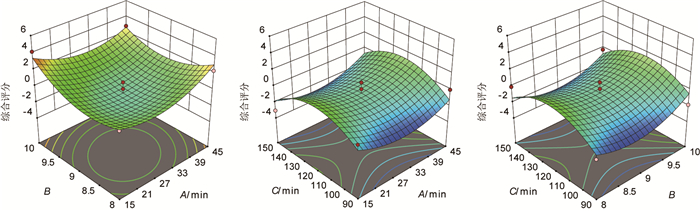
利用Design-Expert13.0软件对试验数据进行多元回归拟合,得到回归方程:综合评分Y=46.990 59-0.135 745A-18.477 84B+0.590 655C-0.028 285AB+0.000 683AC-0.006 330BC+0.005 591A2+1.139 15B2-0.002 288C2方差分析结果见表 5。模型的P值为0.049 2<0.05,失拟项P值为0.664>0.05,表明此方程的回归模型度良好,具有统计学意义,无失拟因素存在,说明该模型拟合度良好,试验误差小,可用此模型对综合评分进行分析和预测。方差分析结果见表,自变量2次项A2、C2显著(P<0.05),表明模型具有统计学意义。各因素对综合评分的影响顺序为B>A>C。结果见图 1。
表 5 拟合回归方程的方差分析结果Table 5. ANOVA results for fitting regression equations方差来源 平方和 自由度 均方 F值 P值 方差来源 平方和 自由度 均方 F值 P值 模型 31.41 6 5.23 3.240 0.049 C2 17.85 1 17.85 11.030 0.008 A 1.32 1 1.32 0.814 0.388 残差 16.18 10 1.62 - - B 1.40 1 1.40 0.867 0.373 失拟态 8.34 6 1.39 0.709 0.664 C 0.19 1 0.19 0.117 0.739 纯误差 7.84 4 1.96 - - A2 6.66 1 6.66 4.120 0.049 B2 5.46 1 5.46 3.380 0.096 3.2.3 响应面分析及BBD试验模型预测
根据回归分析结果,应用Design-Expert 13.0软件,固定3个变量中的某个变量,绘制另外2个变量对综合评分影响的三维曲面。如图 1显示,浸泡时间和料液比对响应值的交互作用较为不显著;浸泡时间和提取时间对响应值具有一定的交互作用;料液比对响应值的交互作用较为显著。经Design Expert 13.0软件分析处理,预测值A=45 min,B=8,C=124.766 min。结合生产实际情况确定肠炎合剂Ⅱ提取工艺参数最优值为加8倍量水、浸泡45 min、提取120 min。
4. 讨论
本研究在肠炎合剂Ⅱ提取工艺优化中,指标成分筛选是核心环节。基于《中国药典》2020版检测标准及文献有效成分报道[18-20],结合预实验结果,最终选定48个指标成分进行工艺考察。通过PCA发现,葛根素、异牡荆素、表小檗碱等具有较高权重值的成分,均为复方药材中主要活性成分,其药理作用覆盖多靶点机制:葛根素、3′-甲氧基葛根素、异牡荆素、葛花苷具有抗炎、抗氧化等作用[21-24]; 千层纸素苷与大豆苷具有清除自由基的能力[25-26]; 葛根素通过上调闭锁蛋白的表达来修复结肠黏液屏障, 进而调节肠道菌群的丰富度, 维持肠道微生态的稳定[27]; 表小檗碱与黄连碱是黄连中起抗炎作用的重要成分[28]。肠炎合剂Ⅱ中各种化学成分从抗炎、抗氧化、调节肠道菌群等方面共同发挥治疗作用。
针对中药复方成分复杂及对照品获取困难的特点,本研究采用UPLC-Q-TOF-MS/MS结合Masshunter质谱数据[1],建立“定性筛选-半定量分析”的双阶段评价体系[29]。通过PCA综合考察48个指标成分的质谱响应度与干膏率,有效克服单一指标评价的局限性,最终确定最优工艺参数:8倍量水、45 min浸泡、120 min提取。该工艺兼具工业化生产的可操作性与质量可控性,成功实现传统制备工艺的现代化转化,为后续制剂开发及新药研究奠定技术基础。
-
表 1 肠炎合剂Ⅱ提取工艺响应面优化设计
Table 1 Response surface optimization design for the decoction process of CYHJ-Ⅱ
试验号 因素 试验号 因素 A/min B/倍 C/min A/min B/倍 C/min S1 15 8 120 S10 30 10 90 S2 45 8 120 S11 30 8 150 S3 15 10 120 S12 30 10 150 S4 45 10 120 S13 30 9 120 S5 15 9 90 S14 30 9 120 S6 45 9 90 S15 30 9 120 S7 15 9 150 S16 30 9 120 S8 45 9 150 S17 30 9 120 S9 30 8 90  下载: 导出CSV
表 2 肠炎合剂Ⅱ的UPLC-Q-TOF-MS/MS鉴定
Table 2 UPLC-Q-TOF-MS/MS identification of CYHJ-Ⅱ
序号 tR/min 准分子离子峰 理论值 实测值 偏差(×10-6) 分子式 化合物 MS/MS 线性关系 中药归属 1 1.014 [M-H]- 133.014 0 133.014 3 2.26 C4H6O5 苹果酸 115.003 8[M-H-H2O]-;71.014 5[M-H-CH2O3]- - HL 2 1.412 [M-H]- 191.019 7 191.020 2 2.62 C6H8O7 柠檬酸 111.008 7[M-H-CH4O4]- - HL 3 4.360 [M-H]- 593.151 2 593.152 5 2.19 C27H30O15 木犀草素-7-O-芸香糖苷 112.985 6[M-H-C23H29O11]- - HQ 4 4.451 [M+H]+ 579.170 8 579.170 7 -0.17 C27H30O14 葛根素-4′-O-葡萄糖苷 417.118 6[M+H-glu]+;
297.075 9[M+H-glu-C4H8O4]+- GG 5 5.000 [M+H]+ 711.213 1 711.212 5 -0.84 C32H38O18 美佛辛-4′-O-葡萄糖苷 579.171 8[M+H-api]+;
417.121 2[M+H-api-glu]+- GG 6a 5.110 [M+H]+ 433.112 9 433.112 8 -0.23 C21H20O10 3′-羟基葛根素 313.070 3[M+H-C8H7O]+ Y=(5×10⁶)X+798 337
R2=0.988 1
线性范围1 332 962~2 499 526GG 7 5.203 [M+H]+ 579.170 8 579.170 7 -0.17 C27H30O14 大豆苷元4′, 7-二葡萄糖苷 417.118 7[M+H-glu]+;
255.065 2[M+H-2glu]+- GG 8a 5.608 [M+H]+ 609.181 4 609.181 2 -0.33 C28H32O15 葛花苷 315.765 0[M+H-glu-api]+ Y=294 644X+128 15
R2=0.984 5
线性范围43 382~108 390GG 9a 5.754 [M+H]+ 565.155 2 565.155 0 -0.35 C26H28O14 3′-氢化葛根素木糖苷 433.112 6[M+H-api]+;
415.103 1[M+H-api-H2O]+Y=(1×10⁶)X+612 19
R2=0.994 5
线性范围219 393~108 390GG 10as 5.835 [M-H]- 563.140 6 563.140 7 0.18 C26H28O14 夏佛塔苷 311.056 3[M-H-glu-C3H6O3]- Y=297 971X+2 702.4
R2=0.988 1
线性范围29 814~96 776GC 11as 6.353 [M+H]+ 417.118 0 417.118 2 0.48 C21H20O9 葛根素 399.106 8[M+H-H2O]+;
381.096 7[M+H-2H2O]+;
363.086 0[M+H-3H2O]+;297.075 5[M+H-C4H8O4]+Y=(9×10⁶)X+3×10⁶
R2=0.966 5
线性范围3 406 759~5 321 768GG 12 6.650 [M-H]- 447.093 3 447.093 0 -0.67 C21H20O11 槲皮素-7-O-鼠李糖苷 327.052 4[M-H-C5H12O3]-;301.058 7[M-H-rha]- - HL 13a 6.706 [M+H]+ 549.160 3 549.161 0 1.28 C26H28O13 葛根素-7-木糖苷 417.118 02[M+H-api]+ Y=(2×10⁶)X+128 965
R2=0.980 2
线性范围339 114~788 186GG 14a 6.943 [M+H]+ 447.128 6 447.128 6 0.00 C22H22O10 3′-甲氧基葛根素 297.075 2[M-H-C6H14O4]- Y=(6×10⁶)X+971 590
R2=0.985 3
线性范围1 566 023~2 868 435GG 15a 7.053 [M+H]+ 549.160 3 549.160 2 -0.18 C26H28O13 葛根素-木糖苷 417.117 8[M+H-api]+;
297.075 4[M+H-glu-C3H6O3]+Y=(4×10⁶)X+334 216
R2=0.993 1
线性范围789 911~1 704 257GG 16s 7.193 [M+HCOO]- 525.161 4 525.163 5 4.00 C23H28O11 芍药内酯苷 121.029 6[M-H-C16H23O9]- - BS 17 7.228 [M-H]- 593.151 2 593.153 1 3.20 C27H30O15 木犀草素-7-O-芸香糖苷同分异构体 112.985 8[M-H-C23H29O11]- - HQ 18 7.349 [M+H]+ 342.170 0 342.170 0 0.00 C20H24NO4 木兰花碱 297.111 8[M-C2H7N]+;
265.085 2[M-C3H11NO]+- HL 19 7.661 [M-H]- 197.045 5 197.046 9 7.11 C9H10O5 丹参素 124.015 5[M-C2H2O3]- - HL 20 7.749 [M+H]+ 579.170 8 579.170 7 -0.17 C27H30O14 山柰苷 447.129 4[M+H-api]+;
327.085 2[M+H-glu-C3H6O3]+- GG 21 7.893 [M-H]- 593.151 2 593.1531 3.20 C27H30O15 山柰酚-3-O-葡萄糖鼠李糖苷 112.985 7[M-H-C23H29O11]-; - HL 22as 7.949 [M+H]+ 417.118 0 417.118 2 0.48 C21H20O9 大豆苷 255.065 3[M+H-glu]+ Y=(7×10⁶)X+1×10⁶
R2=0.990 3
线性范围1 807 758~3 433 738GG 23s 8.007 [M+H]+ 255.065 2 255.064 9 -1.18 C15H10O4 大豆苷元 227.072 4[M+H-CO]+;
199.074 8[M+H-2CO]+- GG 24as 8.118 [M+HCOO]- 525.161 4 525.162 1 1.33 C23H28O11 芍药苷 121.029 7[M-H-C17H24O11]- Y=813 716X+18 155
R2=0.981 6
线性范围116 823~298 943BS 25a 8.498 [M+H]+ 433.112 9 433.112 8 -0.23 C21H20O10 异牡荆素 415.099 7[M+H-H2O]+ Y=(1×10⁶)X+33 510
R2=0.989 6
线性范围149 553~390 528GG 26a 8.874 [M+H]+ 447.128 6 447.130 3 3.80 C22H22O10 3′-甲氧基大豆苷 285.075 9[M+H-glu]+ Y=(3×10⁶)X+194 278
R2=0.984 9
线性范围479 327~1 096 455GG 27as 8.933 [M-H]- 563.140 6 563.141 6 1.78 C26H28O14 异夏佛塔苷 311.056 2[M-H-glu-C3H6O3]- Y=481 281X+11 869
R2=0.987 4
线性范围69 583~176 206GC 28 9.13 [M-H]- 417.119 1 417.118 8 -0.72 C21H22O9 新甘草苷 255.066 1[M-H-glu]- - GC 29 9.164 [M-H]- 463.088 2 463.091 7 7.56 C21H20O12 槲皮素-7-O-葡萄糖苷 301.057 6[M+H-glu]+ - HL 30 9.252 [M+H]+ 417.118 0 417.118 2 0.48 C21H20O9 葛根素同分异构体 351.084 7[M+H-CH6O3]+;
297.075 6[M+H-C4H8O4]+- GG 31 9.332 [M-H]- 549.161 4 549.160 9 -0.91 C26H30O13 甘草素二糖苷 255.065 3[M-H-glu-api]- - GC 32 9.419 [M+H]+ 257.080 8 257.080 2 -2.33 C15H12O4 甘草素同分异构体 137.023 7[M+H-C4H8O4]+;
119.050 3[M+H-C4H8O4-H2O]+- GC 33as 9.448 [M-H]- 417.119 1 417.116 9 -5.28 C21H22O9 甘草苷 255.066 1[M-H-glu]+ Y=715 060X+9 652.2
R2=0.985 5
线性范围91 112~250 066GC 34as 9.650 [M-H]- 549.161 4 549.161 2 -0.36 C26H30O13 芹糖甘草苷 417.120 3[M-H-api]-;
255.065 9[M-H-api-glu]-Y=712 452X+13 502
R2=0.996 0
线性范围95 490~253 162GC 35as 9.714 [M+H]+ 257.080 8 257.080 6 -0.78 C15H12O4 甘草素 137.022 8[M+H-C7H4O2]+;
119.048 2[M+H-C7H4O2-H2O]+- GC 36 9.857 [M+H]+ 447.128 6 447.130 3 3.80 C22H22O10 5-羟基芒柄花苷 285.075 6[M+H-glu]+ - GG 37 10.148 [M+H]+ 463.087 1 463.085 8 -2.81 C21H18O12 野黄芩苷 287.055 6[M+H-C6H8O6]+ - HQ 38 10.286 [M-H]- 547.145 7 547.145 6 -0.18 C26H28O13 白杨素6-C-阿拉伯糖8-C-葡萄糖苷 487.124 5[M-H-C3H6O3]-;
457.113 9[M-H-C3H6O3]-;
427.104 9[M-H-C4H8O4]-- HQ 39 10.350 [M-H]- 253.050 6 253.050 2 -1.58 C15H10O4 7, 4′-二羟基黄酮 146.220 9[M-H-C6H3O2]-;
91.122 9[M-H-C15H6O3]-- GC 40 10.488 [M-H]- 477.103 8 477.107 7 8.18 C22H22O12 异鼠李素-3-O-葡萄糖苷 315.052 1[M-H-glu]- - HL 41 10.581 [M-H]- 547.145 7 547.144 4 -2.38 C26H28O13 白杨素6-C-阿拉伯糖8-C-葡萄糖苷同分异构体 487.123 0[M-H-C3H6O3]-;
457.113 9[M-H-C3H6O3]-;
427.104 7[M-H-C4H8O4]-- HQ 42 10.782 [M+H]+ 324.123 0 324.122 9 -0.31 C19H18NO4+ 去亚甲基小檗碱 309.101 1[M-CH4]+ - HL 43 10.926 [M-H]- 631.166 8 631.167 0 0.32 C30H31O15 没食子酰芍药苷或同分异构体 509.135 0[M-C6H2O3]-;
491.129 6[M-C6H4O4]-- BS 44a 11.192 [M+H]+ 322.107 4 322.107 6 0.62 C19H16ClNO4 小檗红碱 307.083 4[M-H2O]+;
278.089 3[M-CO2]+Y=969 370X+2 915
R2=0.978 0
线性范围113 277~324 960HL 45 11.269 [M-H]- 547.145 7 547.146 2 0.91 C26H28O13 白杨素6-C-葡萄糖8-C-阿拉伯糖苷 487.121 7[M-H-C3H6O32]-;
457.114 4[M-H-C3H6O3]-;
427.104 0[M-H-C4H8O4]-- HQ 46 11.360 [M+H]+ 324.123 0 324.122 9 -0.31 C19H18NO4+ 去亚甲基小檗碱同分异构体 309.101 9[M-CH4]+ - HL 47 11.481 [M+H]+ 503.118 4 503.118 1 -0.60 C24H22O12 丙二酸单酰大豆苷 255.065 3[M+H-glu-C3H2O3]+ - GG 48 11.645 [M-H]- 547.145 7 547.146 4 1.28 C26H28O13 白杨素6-C-葡萄糖8-C-阿拉伯糖苷异构体 487.132 4[M-H-C2H4O2]-;
457.114 6[M-H-C3H6O3]-;
427.099 9[M-H-C4H8O4]-- HQ 49a 11.765 [M+H]+ 563.175 9 563.175 6 -0.53 C27H30O13 3′-羟基葛根素芹菜糖苷 431.134 3[M+H-api]+ Y=(1×10⁶)X+19 146
R2=0.994 3
线性范围139 056~398 862GG 50 11.851 [M+H]+ 352.117 9 352.117 9 0.00 C20H18NO5+ 1, 3-羟基小檗碱 337.093 8[M-CH3]+;
308.093 2[M-C2H4O]+- HL 51 12.524 [M+H]+ 463.123 5 463.123 9 0.86 C22H22O11 射干苷 301.071 2[M+H-api]+ - GG 52a 13.204 [M-H]- 525.161 4 525.162 1 1.33 C23H28O11 芍药苷同分异构体 121.030 3[M-H-C16H23O9]- Y=(5×10⁶)X+49 209
R2=0.994 9
线性范围541 088~1 589 871BS 53a 13.355 [M+H]+ 320.091 7 320.091 9 0.63 C19H14NO4 黄连碱 292.097 1[M-CH4O]+ Y=(6×10⁶)X+119 799
R2=0.996 5
线性范围732 289~1 988 759HL 54a 13.709 [M+H]+ 477.102 8 477.102 9 0.21 C22H20O12 4′-羟基汉黄芩苷 301.070 9[M+H-C6H8O6]+ Y=894 769X+42 033 R2=0.996 5线性范围155 206~330 171 HQ 55a 13.788 [M+H]+ 338.138 7 338.138 7 0.00 C20H20NO4 非洲防己碱 323.115 2[M-CH3]+;
294.112 3[M-C2H4O]+Y=(3×10⁶)X+78 865
R2=0.994 0
线性范围451 550~1 212 765HL 56as 13.875 [M+H]+ 336.123 0 336.123 4 1.19 C20H18NO4 表小檗碱 320.090 6[M-CH4]+;
292.094 9[M-C2H4O]+Y=(4×10⁶)X+35 216
R2=0.993 0
线性范围443 620~1 338 368HL 57as 14.246 [M-H]- 417.119 1 417.120 0 2.16 C21H22O9 异甘草苷 255.065 8[M-H-glu]- Y=178 077X+592.39
R2=0.982 7
线性范围19 090~60 119GC 58a 14.368 [M+H]+ 338.138 7 338.138 7 0.00 C20H20NO4 药根碱 323.115 1[M-CH3]+;
294.112 3[M-C2H4O]+Y=(4×10⁶)X+94 026
R2=0.996 3
线性范围517 392~1 389 040HL 59a 14.570 [M-H]- 549.161 4 549.163 2 3.28 C26H30O13 芹糖异甘草苷 417.129 2[M-H-glu]-;
255.066 8[M-H-2glu]-Y=144 340X+944.02
R2=0.973 2
线性范围15 148~48 418GC 60 14.605 [M+H]+ 255.065 2 255.064 9 -1.18 C15H10O4 3, 2′-二羟基黄酮 227.068 3[M+H-CO]+;
199.074 6[M+H-2CO]+;
137.023 8[M+H-C7H2O2]+- GG 61a 14.628 [M+H]+ 431.133 7 431.132 8 -2.09 C22H22O9 芒柄花苷 269.080 1[M+H-glu]+ Y=(2×10⁷)X+95 045
R2=0.996 4
线性范围270 878~626 273GG 62s 14.721 [M+H]+ 447.092 2 447.092 3 0.22 C21H18O11 黄芩苷 271.061 3[M+H-C6H8O6]+ - HQ 63 14.859 [M+H]+ 271.060 1 271.057 9 -8.12 C15H10O5 黄芩素同分异构体 241.049 5[M+H-CH2O]+ - HQ 64as 14.894 [M+H]+ 433.112 9 433.112 8 -0.23 C21H20O10 染料木苷 271.060 4[M+H-glu]+ - GG 65s 14.977 [M+H]+ 257.080 8 257.080 6 -0.78 C15H12O4 异甘草素 137.023 2[M+H-120]+ - GC 66 15.314 [M-H]- 447.093 3 447.096 8 7.83 C21H20O11 二氢黄芩苷 271.061 5[M+H-C6H8O6]- - HQ 67 15.401 [M+H]+ 334.107 4 334.107 0 -1.20 C20H16NO4 甲基黄连碱 320.090 8[M-CH2]+;
292.085 6[M-C2H2O]+- HL 68a 16.097 [M+H]+ 447.092 2 447.092 1 -0.22 C21H18O11 黄芩苷同分异构体 271.059 7[M+H-C6H8O6]+ Y=(3×10⁶)X+210 844
R2=0.998 7
线性范围557 645~1 350 291HQ 69as 16.361 [M+H]+ 336.123 0 336.123 4 1.19 C20H18NO4 小檗碱 320.099 2[M-CH3]+;
292.097 4[M-CH3-CHO]+Y=(2×10⁷)X+2×10⁶
R2=0.975 6
线性范围4 188 134~8 850 728HL 70a 16.766 [M+H]+ 352.154 3 352.154 8 1.42 C21H22NO4 巴马汀 337.130 2[M-CH3]+;
308.127 8[M-CH3-CHO]+Y=(1×10⁷)X+364 777
R2=0.994 6
线性范围1 467 496~3 853 176HL 71a 16.939 [M+H]+ 477.102 8 477.102 7 -0.21 C22H20O12 5, 6-二羟基-8-甲氧基黄酮-7-O-葡萄糖醛酸苷 301.070 3[M+H-C6H8O6]+ Y=949 395X+20 816 R2=0.990 6线性范围125 376~333 572 HQ 72a 17.744 [M+H]+ 461.107 8 461.108 1 0.65 C22H20O11 千层纸素苷 285.076 3[M+H-C6H8O6]+;
270.053 2[M+H-C6H8O6-CH3]+Y=(9×10⁶)X+736 301 R2=0.986 7线性范围1 625 523~3 530 594 HQ 73a 17.750 [M+H]+ 477.102 8 477.102 9 0.21 C22H20O12 5, 2′-二羟基-6-甲氧基黄酮-7-O-葡萄糖醛酸苷 301.071 4[M+H-C6H8O6]+ Y=536 770X+12 985
R2=0.964 0
线性范围71 845~189 160HQ 74 17.981 [M+H]+ 447.092 2 447.092 4 0.45 C21H18O11 黄芩苷同分异构体 271.059 5[M+H-C6H8O6]+ - HQ 75as 18.380 [M+H]+ 461.107 8 461.108 1 0.65 C22H20O11 汉黄芩苷 285.076 0[M+H-C6H8O6]+;
270.052 2[M+H-C6H8O6-CH3]+Y=(1×10⁷)X+1×10⁶
R2=0.987 5
线性范围2 563 599~5 220 940HQ 76 18.536 [M+H]+ 285.0757 285.074 4 -4.56 C16H12O5 汉黄芩素同分异构体 270.051 3[M+H-CH3]+ - HQ 77 20.034 [M+H]+ 271.060 1 271.061 7 5.90 C15H10O5 黄芩素同分异构体 241.049 5[M+H-CH2O]+ - HQ 78s 21.328 [M+H]+ 271.060 1 271.060 9 2.95 C15H10O5 黄芩素 241.050 5[M+H-CH2O]+ - HQ 79 22.317 [M-H]- 299.056 1 299.058 3 7.36 C16H12O6 高车前素 284.032 9[M-H-CH3]- - HQ 80as 22.749 [M+H]+ 269.080 8 269.080 6 -0.74 C16H12O4 芒柄花素 254.058 4[M+H-CH3]+ Y=633 010X+5 033.5
R2=0.991 8
线性范围66 152~211 146GG 81a 24.856 [M+H]+ 839.406 0 839.405 6 -0.48 C42H62O17 甘草皂苷G2 663.378 4[M+H-C6H8O6]+;
487.341 0[M+H-2C6H8O6]+Y=134 394X+299.92 R2=0.990 0线性范围16 823~44 804 GC 82 25.353 [M+H]+ 839.406 0 839.405 6 -0.48 C42H62O17 羟基甘草酸 663.377 2[M+H-C6H8O6]+;
487.340 7[M+H-2C6H8O6]+- GC 83as 25.665 [M+H]+ 285.075 7 285.075 1 -2.11 C16H12O5 汉黄芩素 270.051 6[M+H-CH3]+ Y=(5×10⁶)X+111 746
R2=0.993 6
线性范围685 348~1 921 796HQ 84 25.902 [M+H]+ 839.406 0 839.405 6 -0.49 C42H62O17 羟基甘草酸 487.341 9[M+H-2C6H8O6]+ - GC 85as 26.098 [M-H]- 821.396 5 821.396 2 -0.36 C42H62O16 甘草酸 351.057 2[M-H-C30H46O4]-;
193.035 2[M-H-C36H52O9]-;Y=784 786X+18 086
R2=0.995 6
线性范围104 473~277 310GC 86 26.509 [M+H]+ 315.086 3 315.086 2 -0.32 C17H14O6 尼泊尔鸢尾异黄酮 285.039 6[M+H-C2H4]+;
213.037 8[M+H-C3H8O4]+- GG 87a 27.254 [M-H]- 821.396 5 821.397 4 1.10 C42H62O16 乌拉尔甘草皂苷B 351.057 1[M-H-C30H46O4]-;
193.035 7[M-H-C36H52O9]-Y=97 776X+2 104.9
R2=0.937 3
线性范围11 345~33 200GC 88 27.432 [M+H]+ 352.117 9 352.117 8 -0.28 C20H17NO5 氧化小檗碱 337.094 9[M-CH3]+;
322.067 9[M-C2H6]+- HL 89a 27.630 [M-H]- 355.118 7 355.117 6 -3.10 C20H20O6 乌拉尔宁 125.024 6[M-H-C14H14O3]- Y=76 299X+1 810.4
R2=0.940 2
线性范围8 133~26 076GC 90 27.984 [M+H]+ 369.133 3 369.133 2 -0.27 C21H23NO5 别隐品碱 341.137 2[M-CO]+;
313.069 5[M-2CO]+- HL 91 27.780 [M-H]- 821.396 5 821.396 2 -0.37 C42H62O16 Licoricesaponin K2或Licoricesaponin H2 645.270 6[M-H-C6H8O6]-;
469.934 0[M-H-2C6H8O6]-- GC 92a 27.919 [M-H]- 367.118 7 367.119 1 1.09 C21H20O6 甘草香豆素 309.039 7[M-H-C4H10]-;
265.041 4[M-H-C5H10O2]-Y=135 276X+438.37
R2=0.994 6
线性范围11 102~44 071GC 93a 28.214 [M-H]- 351.087 4 351.086 6 -2.28 C20H16O6 半甘草异黄酮B 333.077 4[M-H-H2O]-;
265.087 3[M-H-C5H10O]-Y=71 242X+2 322.4
R2=0.958 3
线性范围10 455~25 555GC 94 28.786 [M-H]- 353.103 1 353.103 2 0.28 C20H18O6 甘草异黄烷酮同分异构体 285.032 5[M-H-C5H8]-;
69.694 5[M-H-284]-- GC 95a 29.278 [M-H]- 353.103 1 353.103 1 0.00 C20H18O6 甘草异黄烷酮 285.113 9[M-H-C5H8]-;
83.013 8[M-H-C15H10O5]-Y=336 421X+10 403
R2=0.964 1
线性范围41 424~123 084GC 96a 30.555 [M-H]- 365.103 1 365.101 0 -5.75 C21H18O6 甘草酚 307.024 4[M-H-C4H10]-;
295.025 1[M-H-C5H10]-Y=30 932X+2 295
R2=0.994 7
线性范围3 672~22 317GC 97as 31.421 [M+H]+ 233.153 6 233.153 9 1.29 C15H20O2 木香烃内酯 187.147 0[M+H-CH2O2]+ Y=725 868X+4 969.2
R2=0.991 3
线性范围79 533~244 298MX 98 31.711 [M-H]- 353.103 1 353.102 9 -0.57 C20H18O6 甘草宁C 297.109 8[M-H-C3H4O]- - GC 99a 31.937 [M-H]- 351.087 4 351.086 9 -1.42 C20H16O6 甘草异黄酮B 283.097 6[M-H-C5H8]-;
265.087 3[M-H-C5H10O]-Y=245 044X+2 637.3
R2=0.989 7
线性范围31 047~85 311GC 100as 32.138 [M+H]+ 231.13 8 231.137 8 -0.87 C15H18O2 去氢木香烃内酯 185.132 5[M+H-CH2O2]+;
143.085 7[M+H-C4H8O2]+Y=(2×10⁶)X+758.62
R2=0.994 3
线性范围182 041~594 263MX 101 32.371 [M+H]+ 233.153 6 233.153 0 -2.58 C15H20O2 木香烃内酯同分异构体 159.116 4[M+H-C3H4O2]+ - MX 102 33.533 [M+H]+ 233.153 6 233.153 4 -0.86 C15H20O2 木香烃内酯同分异构体 187.146 0[M+H-CH2O2]+ - MX 103 33.556 [M-H]- 391.191 5 391.193 1 4.09 C25H28O4 光甘草酚 203.071 7[M-H-C13H16O]- - GC 104a 34.452 [M-H]- 423.181 3 423.179 6 -4.02 C25H28O6 Gancaonin E 229.086 5[M-H-C11H14O3]-;
193.086 5[M-H-C14H14O3]-Y=53 303X-9.532 5
R2=0.976 5
线性范围6 008~18 234GC 105 34.827 [M-H]- 407.186 4 407.186 5 0.25 C25H28O5 3-羟基光甘草酚 219.066 2[M-H-C13H16O]-;
187.113 2[M-H-C13H16O3]-- GC 106 35.117 [M-H]- 423.181 3 423.179 3 -4.73 C25H28O6 Gancaonin E及其同分异构体 229.087 1[M-H-C11H14O3]-;
193.086 8[M-H-C14H14O3]-- GC 107a 35.151 [M-H]- 421.165 7 421.165 8 0.24 C25H26O6 Isoangustone 229.087 1[M-H-C11H12O3]-;
193.086 8[M-H-C14H12O3]-Y=34 758X+3 197.7
R2=0.925 8
线性范围7 307~15 103GC 108 35.348 [M-H]- 421.165 7 421.165 1 -1.43 C25H26O6 Kanzonol J及其同分异构体 193.086 5[M-H-C14H12O3]- - GC 109 36.307 [M-H]- 421.165 7 421.164 3 -3.33 C25H26O6 6, 8-Diprenylorobol 193.086 4[M-H-C14H12O3]- - GC 110 36.567 [M-H]- 421.165 7 421.166 8 2.61 C25H26O6 Kanzonol J及其同分异构体 193.086 8[M-H-C14H12O3]- - GC 注:s表示通过对照品确认;a表示选择的指标成分峰;HL、HQ、GG、SY、GC、MX分别为黄连、黄芩、葛根、芍药、甘草、木香的缩写。
下载: 导出CSV
表 3 主成分因子的特征值和方差贡献率
Table 3 Eigenvalue and variance contribution rate of principal component factors
主成分 初始特征值 主成分 初始特征值 总计 方差贡献率/% 累计方差贡献率/% 总计 方差贡献率/% 累计方差贡献率/% 1* 15.275 40.196 40.196 9 0.731 1.925 94.949 2* 8.697 22.887 63.083 10 0.578 1.522 96.471 3* 3.817 10.045 73.128 11 0.401 1.056 97.527 4* 2.605 6.856 79.984 12 0.339 0.892 98.419 5 1.737 4.570 84.553 13 0.239 0.628 99.047 6 1.412 3.716 88.270 14 0.169 0.446 99.493 7 1.006 2.647 90.917 15 0.115 0.301 99.794 8 0.801 2.108 93.024 16 0.078 0.206 100.000 注:*提取平方和载入的主成分。
下载: 导出CSV
表 4 主成分综合得分排序
Table 4 Ranking of principal component comprehensive scores
编号 F1 F2 F3 F4 F 排名 S1 1.410 098 -0.532 968 0.052 862 -0.009 416 0.920 576 5 S2 2.567 818 -0.406 077 -0.099 451 0.059 826 2.122 116 3 S3 2.913 433 0.343 415 0.181 214 -0.235 853 3.202 209 1 S4 2.530 125 -0.004 861 0.042 171 0.139 223 2.706 659 2 S5 0.193 421 -0.998 549 0.231 208 -0.004 142 -0.578 063 11 S6 0.622 337 -0.457 744 -0.058 858 -0.028 677 0.077 059 7 S7 -1.086 255 -1.020 455 -0.352 057 -0.152 843 -2.611 610 17 S8 -0.344 417 -0.512 935 -0.106 078 0.235 623 -0.727 807 12 S9 -2.217 846 -0.447 122 0.318 617 -0.060 745 -2.407 096 16 S10 -1.670 571 -0.261 123 0.093 371 0.052 367 -1.785 956 15 S11 -0.116 915 0.670 675 -0.465 024 -0.080 667 0.008 070 8 S12 -0.979 795 0.840 754 -0.029 109 0.037 730 -0.130 420 9 S13 -1.640 238 0.048 971 -0.039 873 -0.083 554 -1.714 694 14 S14 -1.303 581 -0.026 431 0.028 648 0.058 446 -1.242 918 13 S15 -0.002 829 0.751 881 -0.081 705 0.104 118 0.771 465 6 S16 -1.084 317 0.695 979 0.146 031 -0.042 230 -0.284 537 10 S17 0.209 539 1.316 589 0.138 031 0.010 793 1.674 953 4
下载: 导出CSV
表 5 拟合回归方程的方差分析结果
Table 5 ANOVA results for fitting regression equations
方差来源 平方和 自由度 均方 F值 P值 方差来源 平方和 自由度 均方 F值 P值 模型 31.41 6 5.23 3.240 0.049 C2 17.85 1 17.85 11.030 0.008 A 1.32 1 1.32 0.814 0.388 残差 16.18 10 1.62 - - B 1.40 1 1.40 0.867 0.373 失拟态 8.34 6 1.39 0.709 0.664 C 0.19 1 0.19 0.117 0.739 纯误差 7.84 4 1.96 - - A2 6.66 1 6.66 4.120 0.049 B2 5.46 1 5.46 3.380 0.096
下载: 导出CSV
-
[1] 李素丽, 曹岚岚, 周泉, 等. 鹿红方颗粒提取工艺的优化[J]. 中成药, 2022, 44(11): 3619-3622. DOI: 10.3969/j.issn.1001-1528.2022.11.037 LI S L, CAO L L, ZHOU Q, et al. Optimization of extraction process of luhongfang granules[J]. Chin Tradit Pat Med, 2022, 44(11): 3619-3622. DOI: 10.3969/j.issn.1001-1528.2022.11.037
[2] 黄娟, 钟志容, 张庆莲, 等. 星点设计-效应面法优化五味黄连洗液的水提工艺研究[J]. 中国药物与临床, 2022, 22(5): 403-406. HUANG J, ZHONG Z R, ZHANG Q L, et al. Optimizing the water extraction process of Wuwei Huanglian lotion by response surface methodology with a star point design[J]. Chin Remedies Clin, 2022, 22(5): 403-406.
[3] YANG S H, LIU Y, WANG Q, et al. UPLC-MS/MS identification and quantification of withanolides from six parts of the medicinal plant Datura metel L[J]. Molecules, 2020, 25(6): 1260. DOI: 10.3390/molecules25061260
[4] HUANG A H, CHI Y G, LIU J W, et al. Profiling and pharmacokinetic studies of alkaloids in rats after oral administration of Zanthoxylum nitidum decoction by UPLC-Q-TOF-MS/MS and HPLC-MS/MS[J]. Molecules, 2019, 24(3): 585. DOI: 10.3390/molecules24030585
[5] 张星, 张臻, 林夏, 等. 经典名方制剂开发的主要环节关键技术问题探析[J]. 中草药, 2021, 52(21): 6724-6731. DOI: 10.7501/j.issn.0253-2670.2021.21.031 ZHANG X, ZHANG Z, LIN X, et al. Analysis on key technical issues in main links of classical famous prescription preparations[J]. Chin Tradit Herb Drugs, 2021, 52(21): 6724-6731. DOI: 10.7501/j.issn.0253-2670.2021.21.031
[6] 孔心雨, 李璐, 商晶, 等. 基于UPLC-Q-TOF/MS鉴定健脾益肠散大鼠体内外源物成分[J]. 中草药, 2024, 55(6): 1908-1924. KONG X Y, LI L, SHANG J, et al. Identification of xenobiotics of Jianpi Yichang Powder in rats based on UPLC-Q-TOF/MS[J]. Chin Tradit Herb Drugs, 2024, 55(6): 1908-1924.
[7] ZHENG F J, ZHAO X J, ZENG Z D, et al. Development of a plasma pseudotargeted metabolomics method based on ultra-high-performance liquid chromatography-mass spectrometry[J]. Nat Protoc, 2020, 15(8): 2519-2537. DOI: 10.1038/s41596-020-0341-5
[8] 陈佳美, 陈蓉, 成颜芬, 等. 经典名方葛根芩连汤基准样品的HPLC指纹图谱及量质传递规律研究[J]. 中草药, 2024, 55(4): 1189-1201. CHEN J M, CHEN R, CHENG Y F, et al. Establishment of HPLC fingerprint chromatogram and quantity-quality transmitting of benchmark samples of classical prescription Gegen Qinlian Decoction[J]. Chin Tradit Herb Drugs, 2024, 55(4): 1189-1201.
[9] 徐蓓蕾, 吴迪, 杨娜娜, 等. 基于"通路-疾病" 交互网络的葛根芩连汤及其指标成分组合物干预小鼠溃疡性结肠炎相关结肠癌的作用[J]. 中草药, 2020, 51(19): 4991-4998. DOI: 10.7501/j.issn.0253-2670.2020.19.018 XU B L, WU D, YANG N N, et al. Effect of Gegen Qinlian Decoction and composition of index components on ulcerative colitis related colon cancer in mice based on "pathway-disease" interaction network[J]. Chin Tradit Herb Drugs, 2020, 51(19): 4991-4998. DOI: 10.7501/j.issn.0253-2670.2020.19.018
[10] 蒋志, 蒋丽霞, 李智韬, 等. 中药汤剂煎煮方法及影响因素研究进展[J]. 广州中医药大学学报, 2022, 39(2): 458-462. JIANG Z, JIANG L X, LI Z T, et al. Research progress in decocting methods for Chinese medicine decoction and the influencing factors[J]. J Guangzhou Univ Tradit Chin Med, 2022, 39(2): 458-462.
[11] 周维维. 山楂叶标准汤剂工艺及质量标准研究[D]. 承德: 承德医学院, 2022. ZHOU W W. Study on technology and quality standard of hawthorn leaf standard decoction[D]. Chengde: Chengde Medical College, 2022.
[12] 单丽芳, 杨红梅, 曹蕾, 等. 多指标综合评分法优选参芪复方颗粒提取工艺及其热稳定性考察[J]. 中国实验方剂学杂志, 2016, 22(7): 24-27. SHAN L F, YANG H M, CAO L, et al. Optimization of extraction process of Shenqi compound granules with multi-index comprehensive evaluation method and investigation of its thermal stability[J]. Chin J Exp Tradit Med Formulae, 2016, 22(7): 24-27.
[13] 张冰冰, 欧则民, 严林, 等. 栀子总环烯醚萜和总西红花苷的提取纯化工艺考察[J]. 中国实验方剂学杂志, 2022, 28(11): 156-163. ZHANG B B, OU Z M, YAN L, et al. Optimization of extraction and purification process of total iridoids and total crocins in gardeniae fructus[J]. Chin J Exp Tradit Med Formulae, 2022, 28(11): 156-163.
[14] 卢雪盈, 彭怡文, 姜新根, 等. 正交试验设计优选肝纤颗粒水提工艺[J]. 中国药业, 2019, 28(20): 9-12. DOI: 10.3969/j.issn.1006-4931.2019.20.003 LU X Y, PENG Y W, JIANG X G, et al. Optimization of water extraction process of Ganxian Granules by orthogonal array design[J]. China Pharm, 2019, 28(20): 9-12. DOI: 10.3969/j.issn.1006-4931.2019.20.003
[15] 王婷婷, 安叡, 梁琨, 等. 基于UPLC-LTQ-Orbitrap高分辨质谱的葛根芩连汤的化学成分分析[J]. 中草药, 2020, 51(6): 1498-1507. WANG T T, AN R, LIANG K, et al. Chemical constituent analysis of Gegen Qinlian decoction based on UPLC-LTQ-orbitrap-MS[J]. Chin Tradit Herb Drugs, 2020, 51(6): 1498-1507.
[16] JIN Y R, MA Y H, XIE W W, et al. UHPLC-Q-TOF-MS/MS-oriented characteristic components dataset and multivariate statistical techniques for the holistic quality control of Usnea[J]. RSC Adv, 2018, 8(28): 15487-15500. DOI: 10.1039/C8RA00081F
[17] 王淑, 张翠翠, 郭凤丹, 等. 基于UPLC多指标含量测定和指纹图谱的不同种质金银花药材质量评价研究[J]. 中草药, 2024, 55(3): 947-955. WANG S, ZHANG C C, GUO F D, et al. Quality evaluation of Lonicerae Japonicae Flos with different germplasm based on UPLC content determination and fingerprint[J]. Chin Tradit Herb Drugs, 2024, 55(3): 947-955.
[18] 吴东, 邱晓雨, 黄文平, 等. 基于UHPLC-QTOF-MS/MS辨识比较葛不同部位的化学成分[J]. 江西中医药, 2023, 54(6): 67-73. WU D, QIU X Y, HUANG W P, et al. Identification and comparison of chemical components in different parts of pueraria lobata based on UHPLC-QTOF-MS/MS[J]. Jiangxi Univ Chin Med, 2023, 54(6): 67-73.
[19] 蒋丽施, 李潇彧, 罗曦, 等. 黄连的研究进展及其质量标志物预测分析[J]. 中华中医药学刊, 2023, 41(8): 97-109. JIANG L S, LI X Y, LUO X, et al. Research progress of Huanglian(coptidis rhizoma) and predictive analysis on quality markers[J]. Chin Arch Tradit Chin Med, 2023, 41(8): 97-109.
[20] KONG J R, XIANG Q Z, GE W Y, et al. Network pharmacology mechanisms and experimental verification of licorice in the treatment of ulcerative colitis[J]. J Ethnopharmacol, 2024, 324: 117691. DOI: 10.1016/j.jep.2023.117691
[21] 田赵威, 刘晨风, 王琛. 葛根素在重大慢性疾病临床应用中的探索研究[J]. 中国中医基础医学杂志, 2024, 30(3): 522-529. TIAN Z W, LIU C F, WANG C. Exploratory research on the clinical application of puerarin in major chronic diseases[J]. J Basic Chin Med, 2024, 30(3): 522-529.
[22] 庞会娜, 范琳, 肖凤琴, 等. 指纹图谱结合化学计量法对葛根抗氧化活性部位的药效物质筛选[J]. 中国药房, 2021, 32(7): 839-844. PANG H N, FAN L, XIAO F Q, et al. Effective component screening in antioxidant active fraction of Pueraria lobata by fingerprint combined with chemometrics[J]. China Pharm, 2021, 32(7): 839-844.
[23] 杨骏鹏, 梁犇, 邱莹, 等. 皂荚叶异牡荆素提取及抗氧化、抗菌性能研究[J]. 粮食与油脂, 2024, 37(2): 144-150. YANG J P, LIANG B, QIU Y, et al. Study on the extraction, antioxidant and antibacterial properties of isovitexin from Gleditsia sinensis Lam. leaves[J]. Cereals Oils, 2024, 37(2): 144-150.
[24] 谢璐欣, 黄秋连, 杨碧穗, 等. 基于UPLC-Q-TOF-MS技术分析不同变种来源葛花的化学成分差异性[J]. 中国实验方剂学杂志, 2021, 27(19): 149-156. XIE L X, HUANG Q L, YANG B S, et al. Difference analysis of chemical constituents in different varieties of puerariae Flos by UPLC-Q-TOF-MS[J]. Chin J Exp Tradit Med Formulae, 2021, 27(19): 149-156.
[25] YI Y, ADRJAN B, LI J, et al. NMR studies of daidzein and puerarin: Active anti-oxidants in traditional Chinese medicine[J]. J Mol Model, 2019, 25(7): 202. DOI: 10.1007/s00894-019-4090-8
[26] 王宇卿, 李淑娇. 基于HPLC-ABTS-DAD-Q-TOF/MS的黄芩抗氧化活性成分研究[J]. 中草药, 2019, 50(3): 568-572. WANG Y Q, LI S J. Anti-oxidant components in Scutellaria baicalensis based on HPLC-ABTS-DAD-Q-TOF/MS[J]. Chin Tradit Herb Drugs, 2019, 50(3): 568-572.
[27] WANG Q S, WANG Y L, ZHANG W Y, et al. Puerarin from Pueraria lobata alleviates the symptoms of irritable bowel syndrome-diarrhea[J]. Food Funct, 2021, 12(5): 2211-2224. DOI: 10.1039/D0FO02848G
[28] 吴嘉思, 兰悦嘉, 王俊, 等. 表小檗碱调控CD39-NLRP3-GSDMD焦亡路径改善脓毒症肺损伤的机制研究[J]. 中草药, 2023, 54(1): 112-121. WU J S, LAN Y J, WANG J, et al. Mechanism of epiberberine on ameliorating sepsis-induced lung injury via modulation of CD39-NLRP3-GSDMD and downstream pyroptosis[J]. Chin Tradit Herb Drugs, 2023, 54(1): 112-121.
[29] 肖伟, 张欣, 徐芳芳, 等. 以功效物质为质量目标的中药生产过程质量控制研究与实践[J]. 南京中医药大学学报, 2024, 40(10): 1030-1038. DOI: 10.14148/j.issn.1672-0482.2024.1030 XIAO W, ZHANG X, XU F F, et al. Research and practice on quality control of Chinese medicine production process with functional substances as quality target[J]. J Nanjing Univ Tradit Chin Med, 2024, 40(10): 1030-1038. DOI: 10.14148/j.issn.1672-0482.2024.1030
计量
- 文章访问数: 56
- HTML全文浏览量: 6
- PDF下载量: 6
